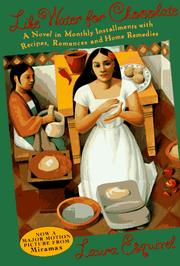
It's been 20 years since the publication of Like Water for Chocolate. Let's just let that sink in for a minute.
OK, so now that I've made some of you feel really old, what I loved about the book and the movie was that I hadn't read romance from the perspective of anyone but white writers for pretty much all of my young life back then with the exception of Nikki Giovanni's Love Poems
 and Alice Walker's The Temple of My Familiar
 .
. So the discovery of Like Water for Chocolate and Mexican novelist Laura Esquivel was amazing. I could finally read love stories that I saw myself in. There's an impact that fiction in particular has on the reader, and I loved developing empathy and understanding for protagonists in love as a nerdy romantic.
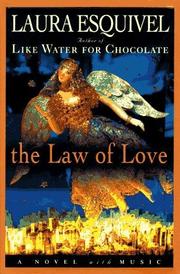
The Law of Love by Laura Esquivel
I'm not ashamed to tell you that I loved this book very much, although in retrospect it was more Harlequin-like than literary. It was all New Agey and unrequited love. It was also my first multimedia experience, but only because the paperback came with a CD in the back that I never listened to. I lost the original hardcover, but found the paperback on sale and I still have it in the house. I don't know why. But it should give you some indication of the romantic nature of the title, at least.

Their Eyes Were Watching God
 by Zora Neale Hurston
If you don't know the story of Janie and Teacake, please don't tell me that you saw what you needed to see if you watched the Halle Berry reproduction because it just doesn't do the love story that Zora crafted justice. This was my first experience with a romantic story written from the purview of a black woman in love as she came of age and I feel lucky that I get to say that.
The Captain's Verses: Love Poems
 by Pablo Neruda
My perpetual crush on poetry began with Ntozake Shange and Audre Lorde, but it completely soared when I was somehow introduced to Pablo Neruda's Twenty Love Poems and a Song of Despair
 . My Spanish still leaves a lot to be desired, but somehow, when I read his poetry in English or Spanish, it hardly matters. If you haven't seen it, Il Postino will make you love Pablo Neruda even more. (Should you need further evidence of my obsession with him, here you go.)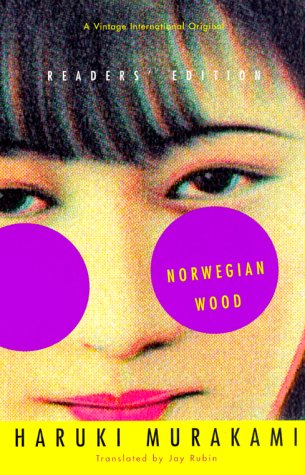
Norwegian Wood
 by Haruki Murakami
The first book of Murakami's that I read was What I Talk About When I Talk About Running , which is very entertaining, but not nearly as beautiful as this endearing and funny love story. I'm reading it now and I have a feeling I'm about to fall down the Murakami fiction rabbit hole. I can't even think about that last 1,000-pager he just published without needing to sit down.
What are you favorite love poems and books? For even more, check out my twin-book-brain strong cookie's list from the 15 authors meme. She includes Paulo Coelho, Sandra Cisneros and Gabriel Garcia Marquez, among many others that I'm also big fans of.


 This is one of my favorite books from the past 20 years. I can't recommend it enough.

 This is one of my favorite biographies in the past decade, in addition to